Distance

What I didn’t expect is how clearly some things would come into focus once I wasn’t inside them every day. How much more I appreciate them. And how little of me is still only American.

I spent twenty-seven months in the Philippines — October 2023 to January 2026. In that time I met, dated, and married Inday. We bought the farm in Dueñas. We developed infrastructure. We built a house for her parents. We lived life.

Then I got on a plane and flew into South Dakota in the middle of January.

That was a shock to the system. Straight from the tropics to a South Dakota winter. I established residency, got my driver’s license, picked up the used F-150 I’d arranged to buy from the Philippines, picked up the Winnebago Thrive 18FBS I live in, and headed south to Texas to get out of the cold.

I spent three months at Big Bend National Park as a Volunteer Backcountry Patrol. I left at the end of April. Had the front cap on the trailer replaced under warranty. Spent a couple of months slowly making my way east to Shenandoah National Park, where I’ve been working as a camp host. I’ll finish here at the end of September, then I have to make my way west to Las Vegas, find a place to store the truck and trailer, and head back to Dueñas for November through March.

That’s the timeline. That’s the frame, not the point.

The point is what distance does.

Inday is at the farm — running things, building our house. I’m back on the itinerant nomad life in the States, volunteering in exchange for a place to park and utilities. We keep the relationship going on video chat and wait for November. While I’m here I’ve also been setting up a trust for my daughter Anju in Connecticut, and gathering the documentation to submit I-130 petitions for Inday and Edrian. Practical life, split across an ocean.

What I didn’t expect is how clearly some things would come into focus once I wasn’t inside them every day. How much more I appreciate them. And how little of me is still only American.

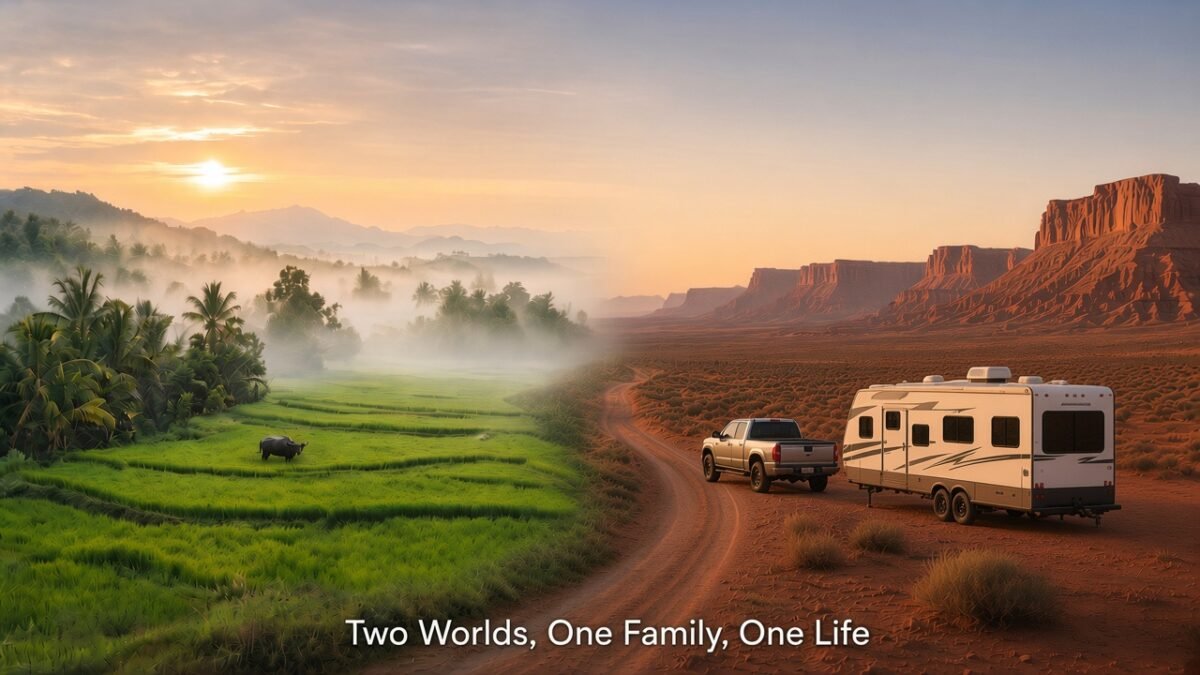
Morning on the farm looks like this: the tubigan — literally “water place,” our riceland — is cultivated with a carabao. Inday gets up, goes outside, and builds a small fire to boil water for coffee. While the water is heating she squats with her phone, and we video chat over the farm-wide mesh network that connects to the Starlink mounted next to the water tower.

Carabao and satellite. Firewood and mesh Wi-Fi. We straddle worlds on the farm. We straddle worlds between the farm and the US.

In the United States, every location has an address. Our off-grid property in Arizona has a 911 address. I had to go into town and show the guys in the county clerk’s office where on their satellite image of my plot the entrance was, so they could register it exactly.

The farm in Dueñas has no address. The address on government paperwork is just the name of the closest named road. If somebody is coming to see us, we tell them to go to the Sawe Barangay Hall, and ask anybody you see where the Kano lives.

I walked into a Walmart not long after I got back. The greeter called out, “Hey Buddy!”

I flinched inside.

I’d grown used to Filipino politeness. Walk into a store with my wife and the guard smiles and says, “Good morning Sir! Good morning Ma’am!” Once we’re shopping, we collect half a dozen clerks who help us find what we need, carry our selections up to the register, wait while we check out, then haul it all out to the truck and load it for us.

Neither version is wrong. They’re just different operating systems. After twenty-seven months on one OS, the other feels loud and abrupt in a way I couldn’t have explained while I was still overseas. Distance made the contrast physical.

I sometimes flinch when I think how crude Kanos must seem to Filipinos.

In the US, when you want to make a point forcefully, you raise your voice and speak sharply. In the Philippines, speaking like that is shameful. You’re demonstrating a lack of self-control. It embarrasses everyone who witnesses it. The one who loses control loses face. And you should never cause anyone to lose face.

I knew that rule existed. Living under it is different from understanding it. From here, I can see how often my low-context brain wanted the American move — say it straight, say it hard, get it done — in a world where that move costs everyone in the room.

On the farm, when I talk to builders or the well driller or the electrician, I know the operating system is different. I don’t know how to emulate that OS in my own brain. I know there is subtext being communicated. I can’t read it.

I don’t know when “Yes Sir” actually means yes, and when it actually means, “Yeah, it would be really great to get this done by next week, but you’re crazy if you think that’s really going to happen.”

I’m autistic. I process language literally. I’m a low-context person living and trying to accomplish things in a high-context society. That mismatch was stressful when I was there. From here, I can name it without drowning in it.

Inday has had to step into the role of translating the Filipino OS for me — and translating me back the other way. That’s an unfair burden. I wish she didn’t have to carry it. She does it anyway, often with a smile and some version of “Sweetie, it’s the Philippines!” She saves me from walking into walls I can’t see, and she softens the walls I create without meaning to.

Building in the province is very different from building in the States. There is no detailed price quote. You start with a sort of general idea. I want a house of so many rooms, about this big. Can we build that for ₱700,000?

A “Yes” doesn’t mean they just agreed to build it for ₱700,000. It means, “Yeah, you’re in the ballpark. But it depends. We can get started.”

Then they’ll tell you what they need to get started. We’ll cut your bamboo over there to build our barracks and for scaffolding. We need this much sand and gravel and cement and rebar to build the footings and columns and tie beams. As time goes by they figure out the next step, and the materials and time needed, and then the next step. It’s all incremental.

On the first couple of projects I was always fearing they were playing the Kano to get more money. Over time I’ve learned that this is simply how it’s done in the province, where it’s common to work until you run out of money, then pause until more money is available.

I couldn’t see that cleanly while I was in the middle of it, bracing for the next surprise. From a campsite in Virginia, with time to think, it looks less like a plot and more like a system I didn’t grow up in.

So that’s where I am. Half a world away from the farm. Talking to Inday on a screen while a carabao works the tubigan and a satellite talks to the sky. Parking the Thrive in exchange for volunteer hours. Doing the paperwork that ties the two halves of this life together. Seeing the Philippines more clearly because I’m not inside it every hour. Appreciating it more for the same reason.

I’ll be back in Dueñas in November. The house will hopefully be done. The farm will have its own new list of incremental surprises. I’ll still be the low-context guy in a high-context world.

But I’m not 100% American anymore. We are a Filipino-American family now.

I’ll be walking back in with a little more distance behind me. Sometimes that’s the only map you get.

Water, Water Everywhere…

Well, that’s what I thought anyway. It’s the tropics. It rains a lot. Everywhere I go I see flooded rice fields. When we started the process of looking for land, I was told by numerous people to make sure the land doesn’t flood in the rainy season. So having an adequate supply of water was never on my radar as a possible issue.

When we bought our land, there were two hand-dug, shallow wells on the property, though we only knew of one of them. The property was very overgrown and the second well was buried in brush. The well we knew of is 18 feet deep, probably about a meter in diameter, and had 12 feet of water in it. That seemed like a lot of water. What I didn’t like about it is that the water was very cloudy, and being an open, shallow well, I’m sure there was a lot of surface contamination. Still, I thought yeah, there’s plenty of water here. But when my in-laws moved onto the property and started using the well every day, the pump quickly ran dry as the well was drawn down and the water level was not replenishing.

If you’ve been following my Facebook, you know that we’ve made a number of attempts to drill a well, and have failed spectacularly over and over. That sure does make me feel incompetent! So I figured I might as well try to lay out the whole story to date here. Note I said “to date” as we still don’t have a reliable source of water. The saga continues.

Our first attempt was hiring a tasok team recommended by the broker who helped us find our land. After agreeing on terms, they came out one bright and promising morning and started to work. They lasted about 3 hours. They hit a chunk of rock they couldn’t drill through or dislodge, and they quit; packed up their gear and went home.

Let’s pause and explain some terms, at least as I understand them. A tasok well is a well that is drilled by hand. There is a drilling rod with a drill bit on the end, and water is pumped into the top of the drilling rod. This is all just like the big truck-mounted drilling rigs used all over the world, just scaled down to be operated by human muscle. The drill rod is lifted up, slammed down, twisted, lifted up, slammed down, twisted, over and over, ad infinitum, all powered by the arms and backs of the tasok crew.

When I asked Inday what the literal meaning of tasok is, she thought for a moment but couldn’t come up with the English word. So she poked me in the ribs and asked “What’s that?” I told her she had poked me and she said “Yes, they poke a hole in the ground.”

So, our first attempt at getting a well drilled lasted only 3 hours and ended in failure. I used to do a lot of work at Harvard Business School back in my video production days, and one theme I heard over and over while working there is that it’s okay to fail, but you should fail fast. Check! We seem to have succeeded at failing fast. Time to regroup.

Our next attempt was another crew of tasok men. This time the crew was from Barotac Vieo, and was led by someone my in-laws know. They spent a couple of weeks living on the property and dug a total of 3 wells in various locations before hitting what they thought was sufficient water. They sunk a PVC well pipe and moved our hand pump over, and it did indeed produce decent water. Unfortunately it didn’t recharge quickly enough and the first time we connected an electric well pump to it, it ran dry in a matter of minutes.

So now I, the impatient American, am starting to lose it. I told Eden we need to quit screwing around and hire someone with a “real” drill rig and get the darned well drilled. I’m sure she could tell you about listening to me rant in frustration over how hard it is to get anything done here in the Philippines. Sweetie, thank you for your patience listening to me vent!

It was at this time that Nathan, Eden’s brother-in-law and the guy who managed the building of the water tower and my in-law’s house, said he had heard of a method of scanning the ground and locating the exact location of water, and suggested we let him investigate this for us. So, a few weeks later we had a couple out to the property with their equipment to do geo resistivity scanning. This is a process of putting electrodes into the ground, shooting an electrical current down into the subsurface, and measuring the resistivity of the various layers of materials. I don’t have any photos of them doing this as the equipment is apparently sensitive enough that they asked everyone to turn off their cell phones while they were doing the survey.

The result of this survey was to identify two spots on our property where there is good water about 60 meters / 200 feet down. One was the preferred spot as they survey showed much less dense material (rock) above the water. They put stakes in the ground at these two spots.

Okay! So now we know where the water is, all we have to do is go get it. To me, this seems like it should be easy. We’ve defined the problem. We need someone who can drill right here for 200 feet. We can even show them a picture of the ground they need to drill through.

Now, no matter how much an impatient autistic American is champing at the bit to get this thing done, nothing happens quickly in the Philippines. Things happen at their own pace. I don’t understand it, but I am (barely) starting to accept it. After some time, Nathan introduced us to a team of deep well drillers. We met and discussed the job in detail. I asked all the questions I could think of to ask, we agreed on a price, and the next week they showed up with their equipment and started to drill at the designated location.

After some days drilling, they hit some rock that for whatever reason they couldn’t get through. At this point, a decision was made, without consulting me, to move the drill spot about 10 meters west and start over. On our next visit to the property I was surprised to see they had changed the location without talking to me, but then I figured 1) they had seen the scan, 2) they’re the professionals and know a lot more about this than I do, and 3) they had discussed it with Nathan and he had approved, so I figured it made sense to go along.

I’m sure you see this coming: After a month of drilling, they finally finished the well, installed the casing and the submersible pump, and started to clear the well. And it failed. All we got was muddy water, and they repeatedly had to stop pumping as the well ran dry.

Now, unlike in America, where you pay drillers by the foot whether they hit water or not, drillers in the Philippines only get their full pay if they produce adequate water. But that doesn’t mean it’s free. The client had to pay all the expense; transportation, fuel, and a daily allowance for food for the crew. Over weeks and weeks of work, that adds up. And there was also a “mobilization fee” for them to start the job. So all these starts and stops with various crews has added up to a tidy sum of money. And we still don’t have a good supply of water. My in-laws will be moving into their new house in the next couple of weeks, but there will be no running water.

Once again, we are in search of a competent well driller who can actually do the job at hand. This time we’re going to see the equipment they intend to use before we agree to hire them. I really don’t think it should be necessary that I know everything there is to know about well drilling just to hire someone to drill a well, but apparently I’m wrong.

The saga continues…

Free Range Life In The Province

I’ve never been a city person. That doesn’t mean I don’t like cities; I do. Cities are amazing. Boston. New York. Dublin. London. Nairobi. Dar es Salaam. And even Iloilo City. These places offer opportunities and experiences and services that you can’t find anywhere else. But that doesn’t mean I want to live there.

In the province, the chickens and ducks are free range. In the province, the dogs are free range. In the province, the children are free range. And in the province, my mind is free range.

And when I say the chickens and ducks are free range, I mean they wander where and when they choose. Someday they will end up as dinner, but in the meantime they get to live fully as chickens and ducks. While they mostly stay pretty close to the house, I am often surprised to run across them in far reaches of the property. A few days after my in-laws brought the chickens from Barotac Viejo, two of them disappeared. The general consensus was that they had ended up in the dinner pot of one or another of the neighbors, which happens sometimes in the province. But some days later one of the neighbors was passing by and let us know that the chickens had been hanging out in their yard. So yeah, the chickens just went visiting and stayed with the neighbors for a week or so.

As for the kids, well, what better place is there to be a kid than out in the province, or, as we say in the West, out in the country? Since it is the summer school break, Edrian has been spending a great deal of time out in Dueñas with Mama Nec. Sometimes one or another of his cousins will be there as well, and their days are filled. There are trees to climb. There are bugs to hunt and capture. There are tadpoles in the old fish pond to be carefully studied. And there are the workmen building the water tower to be watched. And all of these things pull at their attention in rapid succession, such that no time can be wasted and they must move from one attraction to the next at a dead run.

For me, the property represents a lot. I expect it will be my last home. I look forward to building a peaceful, comfortable home where I can feel rooted and content. I love being there. When we drive out from the city, turn up the last dirt track to the property, and pull up and shut off the engine, I feel peace. I love working on the property and seeing the progress of improvement as we shape it to our vision. And I love that when I’m tired, or when I start feeling too hot to work, I am free to quit and go sit in the shade with a cold drink. But the best thing of all, the thing that makes me feel the most content and happy, is when I get to sit under a tree with Eden and we quietly talk about our plans and dreams for our future there. I’ve always preferred looking forward to looking back, and looking forward with a partner is best of all.

Powering Up

Our property in Dueñas has a small house on it, and electricity of a sort. There is no proper connection at the transformer, rather there is a jury-rigged power line, held up on some flimsy bamboo poles, that actually terminates at a neighbors house, and is connected/disconnected there. This worked okay for the previous owners, as the neighbor is a relative of theirs.

So we need to remedy this, and get a proper, and safe, connection to the grid, and our own power bill. Of course, this is the Philippines*, so it’s not a simple matter of going online and ordering service from the power company. Inday has so far spent two half days at two different offices of ILECO, the electric utility that serves our area. We’re nowhere near done with the process, but she has gotten far enough that we have had the master electrician for the utility come to the property to do his site survey and to give us a breakdown of what needs to be done and the cost in order to get hooked up. As part of this we have to install two poles to carry the wire from where it will hook in to the existing power lines, to the house.

To my surprise, the electric utility doesn’t just sell you these poles and charge you for installation. That would be far too easy. Instead the master electrician gave us a list of materials to purchase, and we had to hire a welder to construct the poles from these materials, and a laborer to dig the holes and set the poles. So this past Saturday we set off to the local hardware store to purchase two 20-foot poles, some rebar to be used to construct the foothold for climbing the poles, a couple of insulators to be welded at the top of the poles, and concrete and sand for setting the poles.

There was no way I was going to try to transport these 20-foot poles and rebar in our truck with a 4 1/2 foot bed, so I asked if they could be delivered. In response Inday walked outside and flagged down a passing tricycle driver and asked if he would deliver them to Sawe for us. The driver and the hardware store staff loaded the materials through the middle of the side car, tied everything down securely, and off we went.

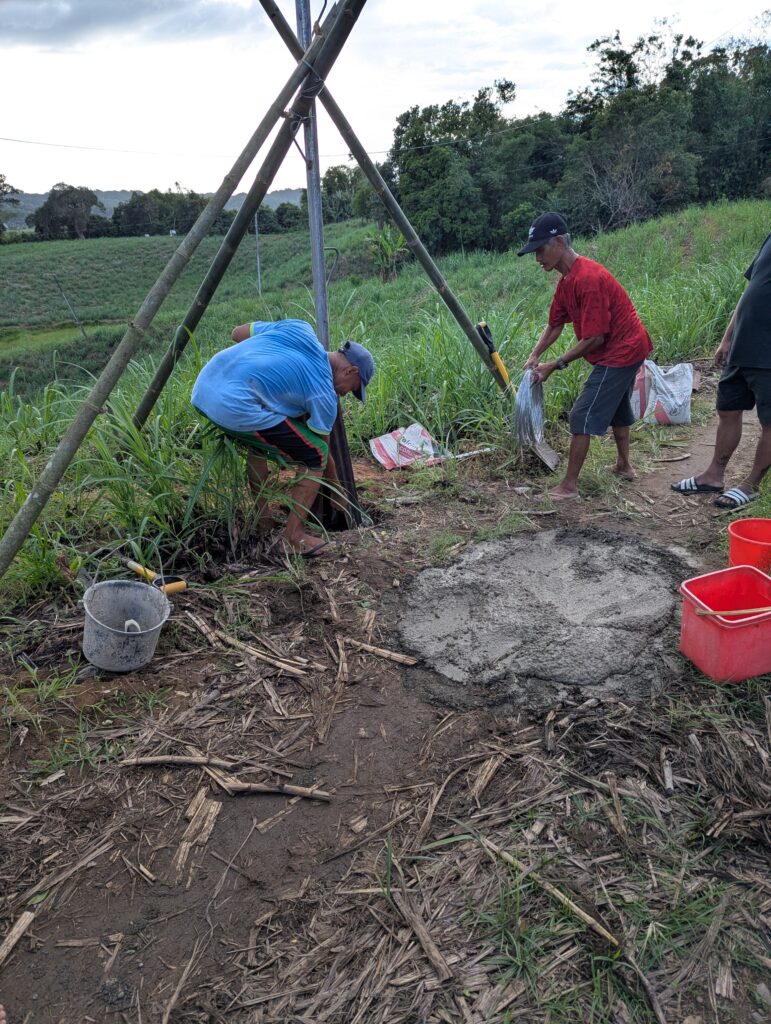
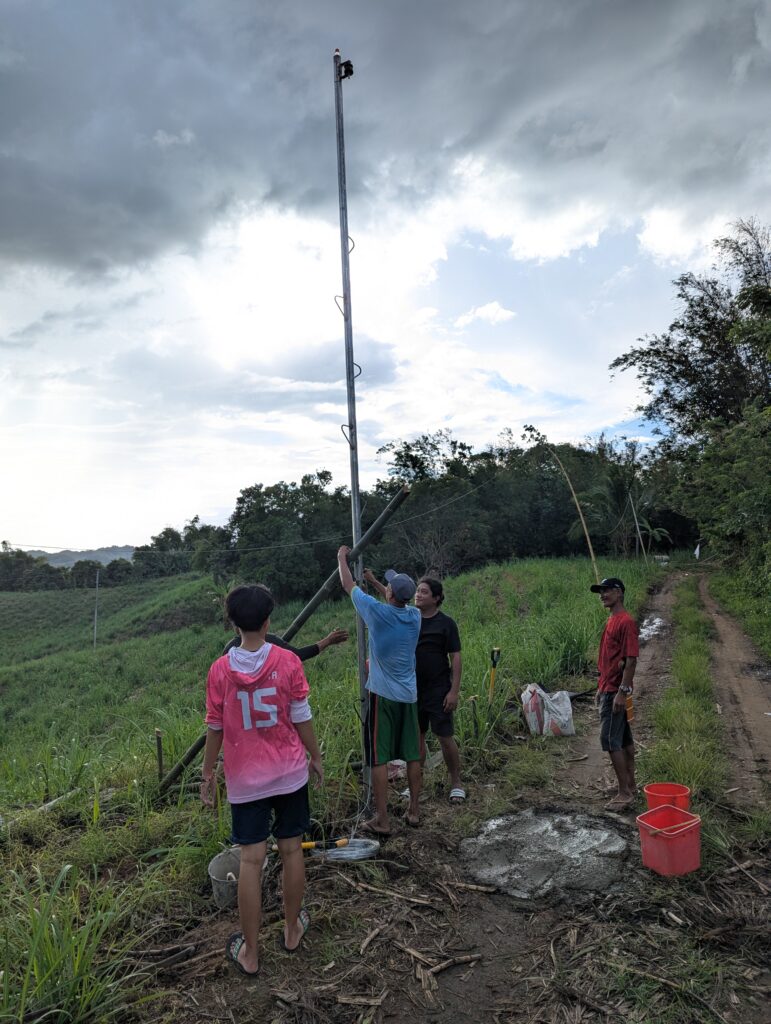
In the afternoon the welder and his helper came by and got to work. They cut and bent the rebar as needed, and built the two poles. Meanwhile the neighbor we hired had dug the holes for the two poles, and my father-in-law cut some bamboo poles to use to brace the poles and hold them in place while the concrete sets.

Once everything was ready everyone set off to set the poles. Cement and sand were mixed on a cleared spot on the road, water was added, the poles were set and braced upright, and concrete was shoveled into the hole. A simple form was made from a piece of metal roofing for the part of the concrete that is required to extend above ground level, and the last of the concrete was shoveled in and leveled.

All in, materials, transportation, and labor, the two poles cost us about $100 USD. But we’re not done yet! There are several more steps to be accomplished before they will actually come out, string the line, and hook us up to the grid. Bureaucracy is a beautiful thing!

*This is becoming an oft-repeated refrain accompanying life here. When I ask silly questions like why we have to do all the work when we’re paying for some service to be provided to us, Inday replies with some version of “Sweetie, it’s the Philippines!”