How I Got Here

The monkeywrench moments chain.

That’s the thing I’ve been thinking about lately. Not the Monkeywrench Moments themselves — I’ve written about those — but how each one made the next one conceivable. The Philippines venture depended on having already done the nomadic RV life. The RV life grew directly out of the AT thru-hike.

I don’t go from 0 to 100. I take one leap — and that leap changes what’s conceivable next.

We get about eighty-five years on earth (though I’ve promised Inday I’ll live to 100). The world is enormous. I’m never going to see or live or experience most of it.

So I try to live as much as I can.

But not as much as I can in the bucket-list sense. I’m not trying to collect experiences. I’m trying not to waste time.

That’s the driver under the Monkeywrench Moments, if there is one. Not a bigger life. A less wasted one, by my own measure.

When a turn shows up, my head doesn’t run a drama. It runs something closer to this: This is a thing I want to do. How do I make it happen? What do I do if I fail? Can I survive that?

Practical questions. Recovery questions. That loop has been running for decades now, and I trust it more than I fear my fear.

Looking back, my adult life doesn’t read as one long arc. It reads as a series of lives, with transitions in between.

Or maybe those are just chapters, and I’m dressing them up. I don’t know. People talk about chapters in their lives all the time. Am I inventing a grander vocabulary so I look bigger to myself? There are certainly people who live much bigger lives than I do.

I’m going to keep using “lives” and “transitions” anyway, because from the inside the breaks feel real — not page turns in one continuous book, but a change of operating system. If that’s self-mythology, fine. It’s the mythology that matches how the time has felt.

There was a first settled life: job, marriage, car payment, house, child, pets. The life you’re supposed to want. And I did. I wanted it. I loved that life.

Then divorce, and single parenting. I’m still not sure whether that was a life of its own or a transition — the fumbling stretch where you know something has to change but you don’t yet know what.

There was a second marriage. A move to Boston. Condo life. No debt. Travel.

Then a Monkeywrench Moment I can name cleanly: I resigned from a job to thru-hike the Appalachian Trail. I didn’t go back to the corporate world. I started a video business with Jodi. We met people. We grew the business. It was a new world. A good life, right up until the question showed up: we’ve built this — now what?

Another divorce. I drove away from that life in a motorhome and spent nearly five years on the road. That was a life! I wouldn’t trade that experience for anything, as lonely as it eventually became.

Was Johnson City apartment life a life, or another transition? It didn’t suit me. Sometimes that’s how you know you’re still fumbling: you can feel the misfit before you can name the next turn.

Then the Philippines. Inday. The farm. The leap that scared me the most — and the one that made the whole chain make sense.

And ahead of me — and already under my feet — this bi-hemispheric life: America and the Philippines, one existence spanning both.

And it’s not just the geography. It’s the juxtaposition. West and East, side by side in an ordinary day. Carabao and Starlink.

I’m not going to try to explain people who live one life all the way through. I don’t know their insides. I only know mine.

Here’s what I’ve noticed about the transitions.

Sometimes you know a change is needed, but not what the change is. You fumble around for a while until it makes itself clear.

That’s okay. You still wake up every morning and eat breakfast.

The fog isn’t failure. It’s the in-between.

And here’s what I’ve noticed about the leaps themselves.

In the moment, these turns don’t feel “larger.” That word is a rearview word. At the time they’re fitting. The right size. The size of change that’s acceptable in your life, because you’ve made changes before and change is part of your operating system now.

Only looking back do they line up as incrementally bigger: trail, then road, then another country, and now this bi-hemispheric life.

That’s what distance does. I wrote about it in the Distance post — how stepping away from the Philippines finally let me see it clearly. It works the same way with time. You can’t see the chain while you’re inside it. I couldn’t see the Filipino operating system while I was living under it, either. Step back far enough — an ocean, a few years, a couple of lives — and the shape appears.

Limitations, for me, are mostly mental.

I posted a Facebook memory of my dad not long ago. My brother commented on how long ago that was — eight years! And I thought: That was only eight years ago? My God, I’ve lived three lives since then.

That’s what this feels like from the inside. Not one long career narrative. Stacked lives. Dense time. The density is the point.

When I was first exploring moving overseas, I struggled deeply with it. It scared me. Was this too big? Was I too old? If it was a mistake, could I recover?

I even paid an online therapist for an hour just to talk it through. (Worth every penny, by the way. Sometimes you have to say the scary thing out loud to a stranger to hear what it really sounds like.)

The questions were still the same practical loop: How do I make this happen? What if I fail? Can I survive that?

I made the leap anyway. Because it was a thing I wanted to do, and I could see a path, and I believed I could survive being wrong.

So where does that leave the Monkeywrench Theory, years after that first post?

Still the idea that sometimes you throw a wrench into the works, blow up a life, and start over.

Still the choice to lean toward the itch instead of talking yourself out of it with “I have a life; I can’t quit now.”

Still not a claim that my life is big. Only that I keep trying not to waste the stretch of years I’ve got.

As my brother once said to me: “Your life isn’t boring!”

No. It isn’t. One fitting leap at a time, breakfast in the fumbling, and a chain that somehow got me to Inday, the farm, and a bi-hemispheric life I couldn’t have pictured from the first settled chapter.

Distance

What I didn’t expect is how clearly some things would come into focus once I wasn’t inside them every day. How much more I appreciate them. And how little of me is still only American.

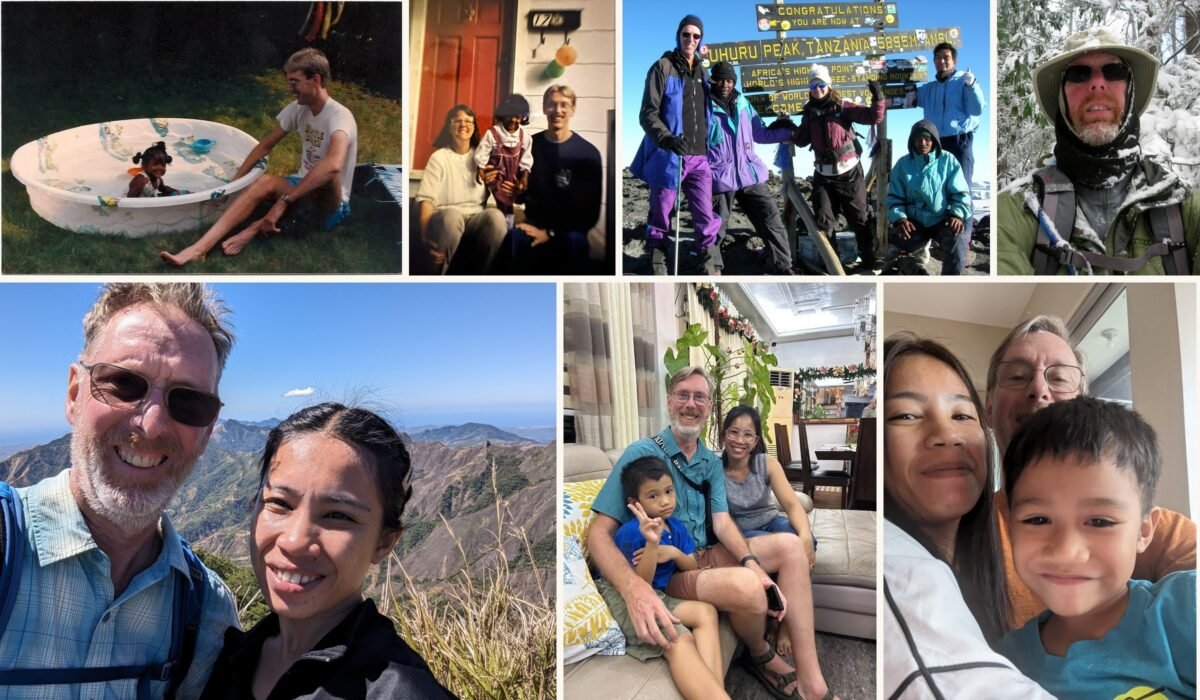
I spent twenty-seven months in the Philippines — October 2023 to January 2026. In that time I met, dated, and married Inday. We bought the farm in Dueñas. We developed infrastructure. We built a house for her parents. We lived life.

Then I got on a plane and flew into South Dakota in the middle of January.

That was a shock to the system. Straight from the tropics to a South Dakota winter. I established residency, got my driver’s license, picked up the used F-150 I’d arranged to buy from the Philippines, picked up the Winnebago Thrive 18FBS I live in, and headed south to Texas to get out of the cold.

I spent three months at Big Bend National Park as a Volunteer Backcountry Patrol. I left at the end of April. Had the front cap on the trailer replaced under warranty. Spent a couple of months slowly making my way east to Shenandoah National Park, where I’ve been working as a camp host. I’ll finish here at the end of September, then I have to make my way west to Las Vegas, find a place to store the truck and trailer, and head back to Dueñas for November through March.

That’s the timeline. That’s the frame, not the point.

The point is what distance does.

Inday is at the farm — running things, building our house. I’m back on the itinerant nomad life in the States, volunteering in exchange for a place to park and utilities. We keep the relationship going on video chat and wait for November. While I’m here I’ve also been setting up a trust for my daughter Anju in Connecticut, and gathering the documentation to submit I-130 petitions for Inday and Edrian. Practical life, split across an ocean.

What I didn’t expect is how clearly some things would come into focus once I wasn’t inside them every day. How much more I appreciate them. And how little of me is still only American.

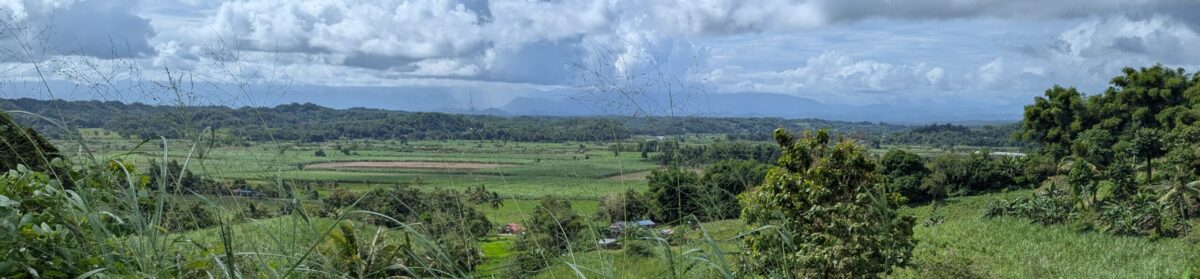
Morning on the farm looks like this: the tubigan — literally “water place,” our riceland — is cultivated with a carabao. Inday gets up, goes outside, and builds a small fire to boil water for coffee. While the water is heating she squats with her phone, and we video chat over the farm-wide mesh network that connects to the Starlink mounted next to the water tower.

Carabao and satellite. Firewood and mesh Wi-Fi. We straddle worlds on the farm. We straddle worlds between the farm and the US.

In the United States, every location has an address. Our off-grid property in Arizona has a 911 address. I had to go into town and show the guys in the county clerk’s office where on their satellite image of my plot the entrance was, so they could register it exactly.

The farm in Dueñas has no address. The address on government paperwork is just the name of the closest named road. If somebody is coming to see us, we tell them to go to the Sawe Barangay Hall, and ask anybody you see where the Kano lives.

I walked into a Walmart not long after I got back. The greeter called out, “Hey Buddy!”

I flinched inside.

I’d grown used to Filipino politeness. Walk into a store with my wife and the guard smiles and says, “Good morning Sir! Good morning Ma’am!” Once we’re shopping, we collect half a dozen clerks who help us find what we need, carry our selections up to the register, wait while we check out, then haul it all out to the truck and load it for us.

Neither version is wrong. They’re just different operating systems. After twenty-seven months on one OS, the other feels loud and abrupt in a way I couldn’t have explained while I was still overseas. Distance made the contrast physical.

I sometimes flinch when I think how crude Kanos must seem to Filipinos.

In the US, when you want to make a point forcefully, you raise your voice and speak sharply. In the Philippines, speaking like that is shameful. You’re demonstrating a lack of self-control. It embarrasses everyone who witnesses it. The one who loses control loses face. And you should never cause anyone to lose face.

I knew that rule existed. Living under it is different from understanding it. From here, I can see how often my low-context brain wanted the American move — say it straight, say it hard, get it done — in a world where that move costs everyone in the room.

On the farm, when I talk to builders or the well driller or the electrician, I know the operating system is different. I don’t know how to emulate that OS in my own brain. I know there is subtext being communicated. I can’t read it.

I don’t know when “Yes Sir” actually means yes, and when it actually means, “Yeah, it would be really great to get this done by next week, but you’re crazy if you think that’s really going to happen.”

I’m autistic. I process language literally. I’m a low-context person living and trying to accomplish things in a high-context society. That mismatch was stressful when I was there. From here, I can name it without drowning in it.

Inday has had to step into the role of translating the Filipino OS for me — and translating me back the other way. That’s an unfair burden. I wish she didn’t have to carry it. She does it anyway, often with a smile and some version of “Sweetie, it’s the Philippines!” She saves me from walking into walls I can’t see, and she softens the walls I create without meaning to.

Building in the province is very different from building in the States. There is no detailed price quote. You start with a sort of general idea. I want a house of so many rooms, about this big. Can we build that for ₱700,000?

A “Yes” doesn’t mean they just agreed to build it for ₱700,000. It means, “Yeah, you’re in the ballpark. But it depends. We can get started.”

Then they’ll tell you what they need to get started. We’ll cut your bamboo over there to build our barracks and for scaffolding. We need this much sand and gravel and cement and rebar to build the footings and columns and tie beams. As time goes by they figure out the next step, and the materials and time needed, and then the next step. It’s all incremental.

On the first couple of projects I was always fearing they were playing the Kano to get more money. Over time I’ve learned that this is simply how it’s done in the province, where it’s common to work until you run out of money, then pause until more money is available.

I couldn’t see that cleanly while I was in the middle of it, bracing for the next surprise. From a campsite in Virginia, with time to think, it looks less like a plot and more like a system I didn’t grow up in.

So that’s where I am. Half a world away from the farm. Talking to Inday on a screen while a carabao works the tubigan and a satellite talks to the sky. Parking the Thrive in exchange for volunteer hours. Doing the paperwork that ties the two halves of this life together. Seeing the Philippines more clearly because I’m not inside it every hour. Appreciating it more for the same reason.

I’ll be back in Dueñas in November. The house will hopefully be done. The farm will have its own new list of incremental surprises. I’ll still be the low-context guy in a high-context world.

But I’m not 100% American anymore. We are a Filipino-American family now.

I’ll be walking back in with a little more distance behind me. Sometimes that’s the only map you get.